Custom web scraping services for businesses
Public web data, extracted properly: parsed, deduplicated, verified and delivered in a format your team can work the same morning.
At handover you get
- A repeatable pipeline, not a one-off dump
- Run logs showing what was pulled, what was rejected and why
- Delivery to CSV, Sheets, database, webhook or CRM
- Source code and documentation in your hands
Fixed price agreed in writing before development starts. Hosting and maintenance are optional, and nothing stops working if you decline them — you hold the code.
Web scraping is easy to demo and hard to run. Anyone can pull a thousand rows once. The difficulty is doing it every week without duplicates, without dead phone numbers, without the file quietly going stale while your reps keep dialling it.
We treat extraction as the first quarter of the job. The other three quarters are normalisation, deduplication, verification and delivery — the parts that decide whether the output is a spreadsheet nobody opens or a working pipeline.
Where it fits
- Lead Scraper Development
- Data Enrichment & Verification
- Custom Lead Database
- Lead Generation Automation
- CRM Integration & Lead Routing
- Lead Scoring & Prioritisation
- Public Records Data Mining
Most projects are one build type. Some are two joined together — a scraper feeding a database, or enrichment feeding a CRM integration.
What the build covers
Extraction
Crawlers written per source, with the crawl budget spent where records actually live rather than brute-forcing an entire domain.
Normalisation
Addresses standardised, phone numbers formatted, categories mapped to one vocabulary, names cleaned of the noise that public directories are full of.
Deduplication
Fuzzy matching across sources so the same business arriving from three directories becomes one record with three confirmations, not three rows.
Verification
Every record checked for signs of life before it ships — reachable website, resolving domain, plausible phone format, business not marked closed at the source.
How PermitPulse collects its records
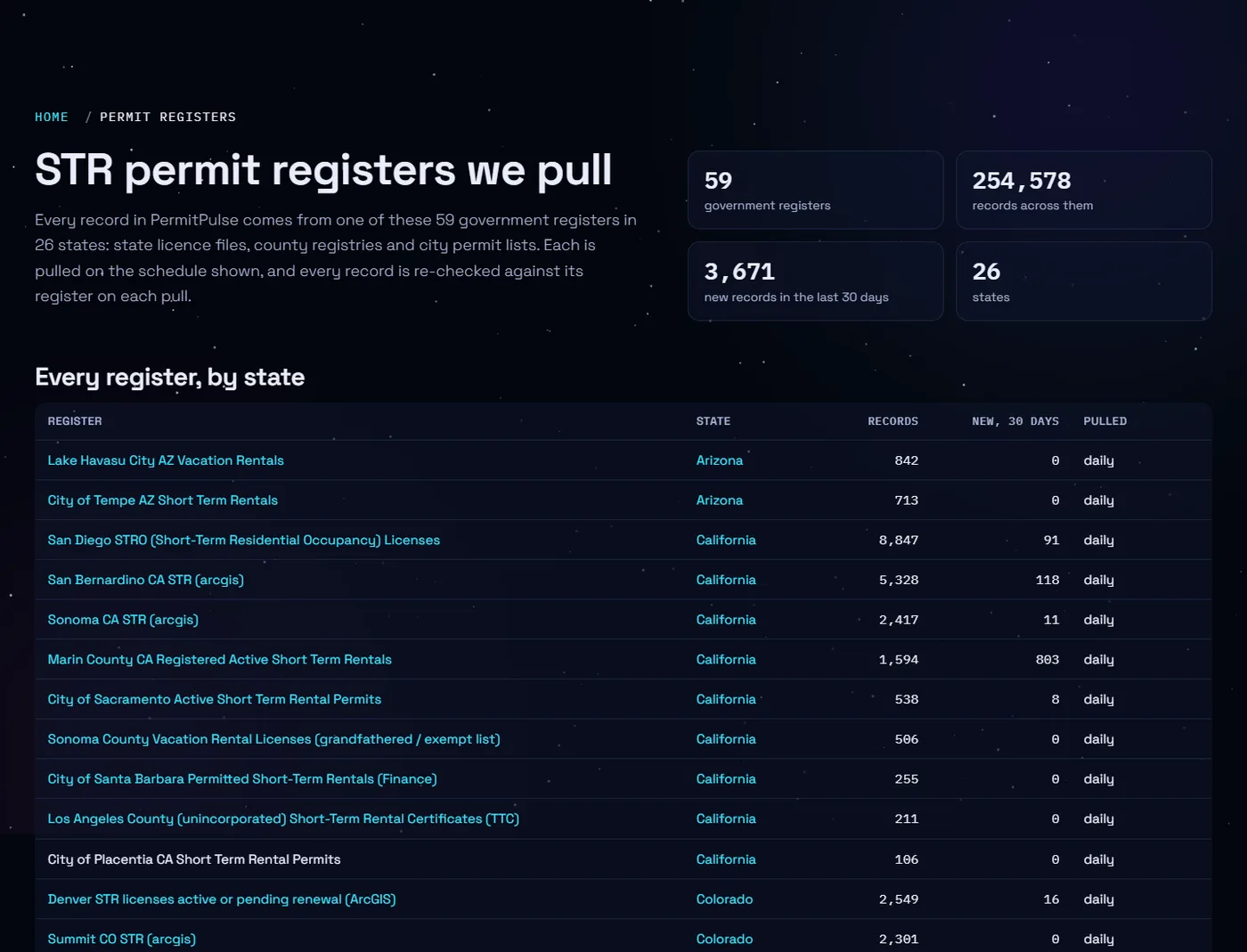
Most of what people call scraping is reading a publisher's own data interface. PermitPulse, the permit dataset this company runs, reads New Orleans and Texas records through their Socrata open-data APIs, Portland, Denver and Traverse City through ArcGIS map and feature services, and Florida's license file as the state's own district CSV extracts. Each register is pulled on a schedule, and every record is checked against its register again on each pull.
The result is 283,611 records, 125,065 with a phone and 64,233 with an email. When a source only exists as web pages, the rule stays the same: public pages only, nothing behind a login.
- What sets the number: how many sources have to be parsed, how clean those sources are, how much data moves, and where the output has to land — not how long we spend.
- Fixed, in writing, before development starts. A paid source-mapping phase comes first so the quote is based on what the records actually contain.
- Hosting and maintenance are optional. Decline them and everything still runs, because you hold the code.
- No per-lead fees. We do not meter your own data back to you.
Questions
Is web scraping legal?
Collecting information that is published publicly is broadly lawful in the United States, and government registers are published specifically so the public can use them. The risk is not usually in collection — it is in what you do next. Contract terms, copyright, personal data and outreach rules (TCPA, CAN-SPAM, state Do-Not-Call) all bite after collection. We build to public sources only and tell you plainly where the line sits for your use case. We are not lawyers, and for a novel use you should ask one.
Do you sell the data you scrape for us?
No. Work built for a client belongs to that client. The lists we sell on the rest of this site are mined from our own sources for our own catalogue — they are a separate product, and your build does not feed them.
How is this different from buying a data subscription?
A subscription rents you somebody else's schema, refreshed on somebody else's timetable, and it stops the month you stop paying. A build gives you the pipeline itself. If your targeting is unusual — a niche category, an odd geography, a filter no vendor offers — a subscription will never fit it and a build will.
Other build types
Lead Scraper Development
A scraper built for one job: your sources, your fields, your filters — running on a schedule and dropping clean records where your team already works.
Read more →Data Enrichment & Verification
Take the list you already have, fill the gaps from public sources, kill the dead records, and keep it that way on a schedule.
Read more →Custom Lead Database
A private database of your market — built once from public sources, kept current automatically, searchable by the people who have to call it.
Read more →Lead Generation Automation
The whole chain, wired end to end: find, verify, score, route, notify. No one on your team copying rows between tools.
Read more →CRM Integration & Lead Routing
Get sourced records into the system your reps already live in — matched, deduplicated against what is already there, and assigned correctly on arrival.
Read more →Lead Scoring & Prioritisation
Rank the list before anyone dials it — on signals from your own closed deals, not a vendor's black box.
Read more →Public Records Data Mining
Government registers publish business events every day — new entities, new licences, new permits. Software that watches them turns filings into first-mover leads.
Read more →Guides for buyers
Where we build
How the registers behind PermitPulse are read
On October 23, 2026 the PermitPulse pipeline had 64 registers on a schedule. 43 of them are read through ArcGIS map and feature services, 14 through Socrata open-data APIs and 7 from files the publisher posts. None needs a browser: each publisher already offers a machine interface, and reading it is faster and kinder to the server than rendering pages.
62 of the scheduled registers run once a day and 2 every four hours. Every run reads the register again, adds what is new and marks the rows it found again as re-verified, so a permit that disappears from the register can be told apart from one that is still there. In the 24 hours before that count, 62 of 64 runs finished cleanly. The other 2 returned errors: one register had started asking for a sign-in token, which ends collection from it, and one sent back an incomplete response, which the next run retries.
A further 96 datasets were imported once from files their publishers posted and are not polled. Keeping the two apart matters: a one-time file is a snapshot, and a buyer should know which records can go stale.
| How the source is read | Registers |
|---|---|
| ArcGIS map and feature services | 43 |
| Socrata open-data APIs | 14 |
| Files the publisher posts (CSV) | 7 |
| One-time imports of published datasets, not polled | 96 |
Describe the problem, not the spec.
Tell us who you are trying to reach and how you find them today. We come back with a source map, a fixed price, and an honest note on anything we do not think will work.